Green Day once sang, “Wake me up when September ends.” But this September has been anything but a lull—it has been restless, eventful, and impossible to sleep through. Surprises have come thick and fast, from the tremors of international affairs to the ripples within our own nation. Yet, this reflection is not about the whirlwinds of the month.
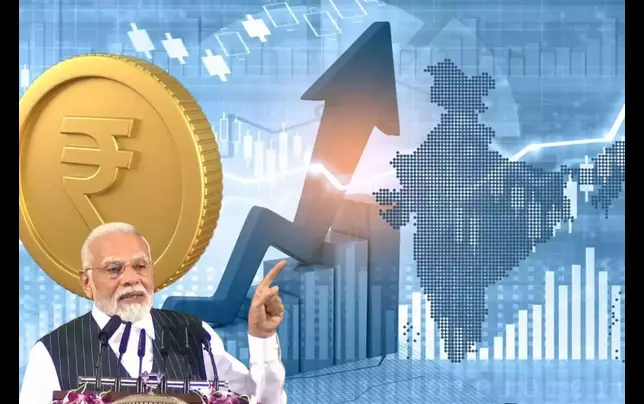
On September 17 2025, Prime Minister Narendra Modi turned 75, marking more than a decade at the helm since 2014. His tenure has been defined by politics and a steady rhythm of economic reforms that have reshaped India’s story. From financial inclusion to digital payments, from bold tax reforms to attempts at reimagining agriculture and labour, from corporate tax cuts to privatisation drives—each step has left its imprint on the nation’s economic canvas.
This write-up does not claim to capture every turn in that journey. Still, it seeks to briefly touch upon many of those milestones—moments where policy met vision, and where ambition sought to redraw the contours of India’s economy.
- Goods and Services Tax (GST), 2017 – The Goods and Services Tax represents India’s most comprehensive indirect tax reform since independence. Introduced on July 1, 2017, GST replaced a complex web of central and state levies, including Value Added Tax, Central Excise Duty, and Service Tax. The tax operates on a destination-based consumption model where tax is collected at the point of consumption rather than production. GST follows a multi-stage collection process with an Input Tax Credit mechanism ensuring that tax is levied only on value addition at each stage of the supply chain. This eliminates the cascading effect of taxes under the previous regime, where taxes were imposed on already taxed goods.
- Goods and Services Tax (GST) 2.0, 2025 – The Next-Gen GST reform introduces a streamlined structure with two primary rates that replace the previous four-slab system. The Merit Rate of 5% applies to essential goods and services that form part of everyday consumption. The Standard Rate of 18% covers most other items in the economy. A Demerit Rate of 40% applies exclusively to luxury and sin goods. This transformation simplifies the previous system, including multiple rates, cesses, and exemptions. The rationalisation of GST slabs affects numerous categories across different sectors of the economy, providing clarity and reducing disputes that plagued the earlier framework. Changes have been suggested, including reforms like inverted duty structure corrections and an enhanced services framework.
- Insolvency and Bankruptcy Code (IBC), 2016 – Before the IBC, the legislative framework for insolvency and restructuring was fragmented across multiple legislations, such as the Companies Act 2013, the Sick Industrial Companies (Special Provisions) Act, 1985, Securitization and Reconstruction of Financial Assets and Enforcement of Security Interest Act, 2002, the Recovery of Debts due to Banks and Financial Institutions Act (RDDBFI Act), 1993, and others. However, it created a consolidated framework that governs insolvency and bankruptcy proceedings for companies, partnership firms, and individuals.
Apart from the above three landmark reforms , the Modi government introduced many other measures that reshaped India’s economic landscape in visible ways. Large public sector bank mergers and massive recapitalisation created stronger institutions in the banking sector. At the same time, Jan Dhan Yojana brought millions of families into the formal financial system. The Unified Payments Interface (UPI) revolution made India the global leader in digital payments. On the industry and business front, initiatives like Make in India, the Production Linked Incentive (PLI) scheme, and targeted ease of doing business reforms were rolled out to position India as a global manufacturing hub. For farmers and rural India, schemes such as PM-KISAN and e-National Agriculture Market aimed to boost incomes and modernise agri-markets. Consolidating 29 laws into four modern labour codes signalled a bold attempt to simplify regulations, even as critics worried about worker protections. On the welfare side, the JAM trinity (Jan Dhan, Aadhar, Mobile) enabled direct transfers of subsidies, Ujjwala Yojana provided clean cooking fuel to millions of households, and DBT plugged leakages across schemes. During the pandemic, the Atmanirbhar Bharat package and emergency credit lines kept small businesses afloat and infused resilience into the economy. Internationally, the government pushed FDI liberalisation, scrapped the retrospective tax that had long haunted investors, and marked a milestone with the privatisation of Air India. Coupled with corporate tax cuts and a more transparent, faceless assessment system, these reforms reflected a consistent push towards formalisation, digitalisation, and global competitiveness, even if their outcomes remain uneven and contested in certain areas.